Mentoring, teaching, and outreach

Teach mathematics as a language for intelligent systems.

My educational goal is to help students connect rigorous models and proofs to decisions, networks, autonomous systems, and societal impact.

student ownershiptheory ↔ practiceinclusive learningpublic communication
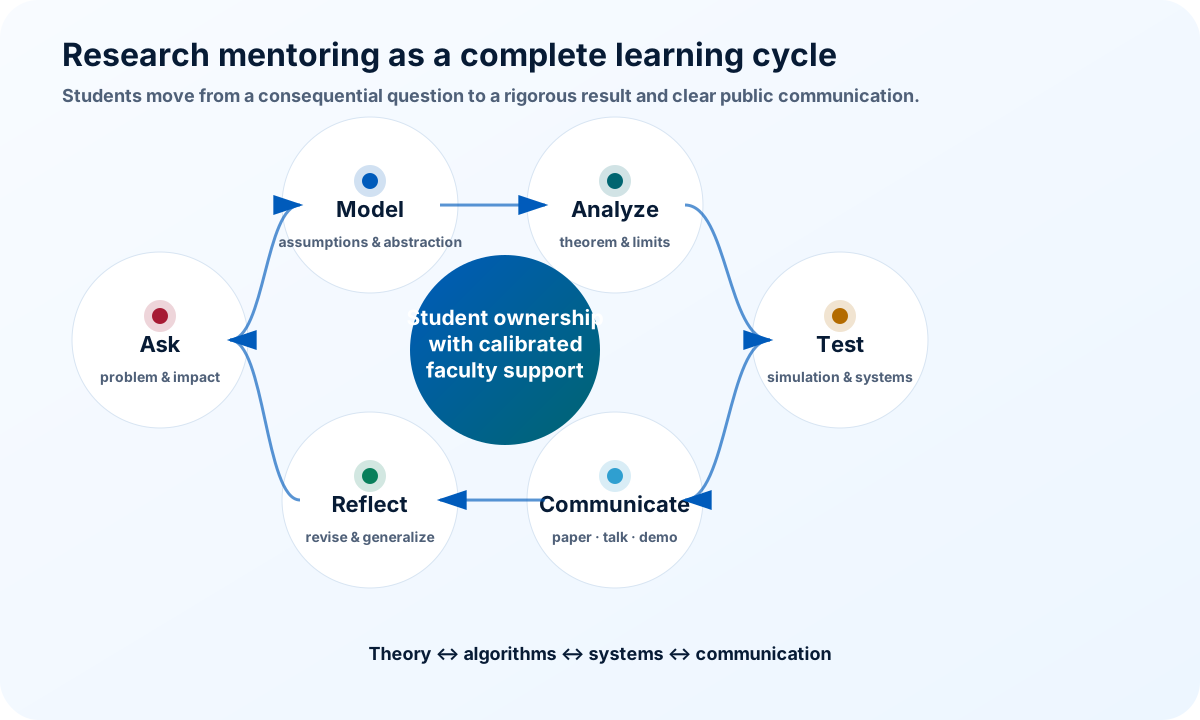
Mentoring cycle connecting questions, models, analysis, experiments, communication, and reflection.
A complete research education: ask, model, analyze, test, communicate, and generalize.
Research group

Ph.D. students at the University at Buffalo.

Mentoring combines ambitious theory, careful validation, independent ownership, and opportunities to communicate results through papers, talks, and outreach.

Research mentoring cycle from question formulation through modeling, proof, experimentation, communication, and reflection.
Students are guided toward independent judgment—not only completion of a predefined task.
Mentoring philosophy

From a consequential question to an independent research identity.

01

Start from the decision consequence

Clarify what matters operationally, who is affected, and why a mathematical abstraction is needed.

02

Build the simplest model that preserves the difficulty

Separate assumptions, information structure, constraints, and performance goals before adding complexity.

03

Prove, test, and diagnose

Use theory, lower bounds, numerical experiments, and systems evidence to understand when a method works and why it fails.

04

Communicate for different audiences

Develop technical papers, proposal narratives, research talks, visual explanations, and educational demonstrations.

Teaching portfolio

Courses that connect mathematical foundations to communication, learning, and networked systems.

Each course serves both undergraduate intuition and graduate-level depth through geometry, proofs, algorithms, examples, and open-ended projects.

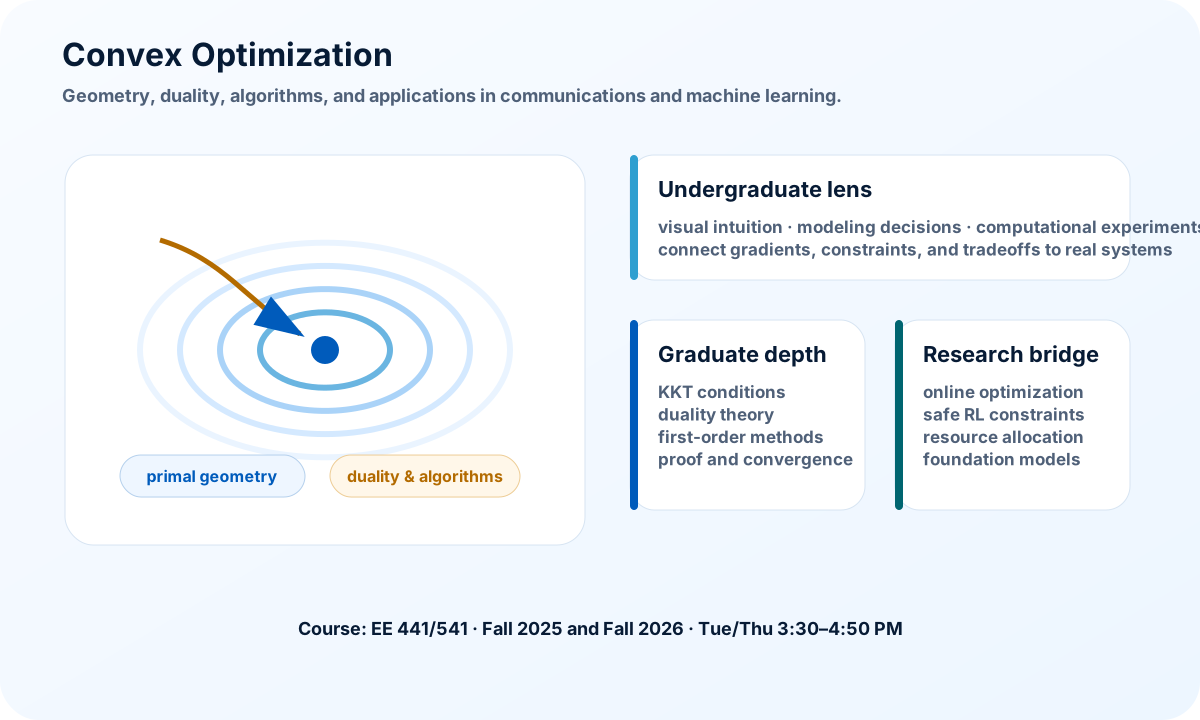
Convex optimization illustration with level sets, algorithms, and research connections.
EE 441/541 · Fall 2025 and Fall 2026 · Tue/Thu 3:30–4:50 PM

Convex Optimization with Applications in Communication and Machine Learning

Students learn to translate engineering and learning problems into optimization models, recognize convex structure, use duality, analyze algorithms, and interpret computational results.

Undergraduate developmentgeometric intuition, modeling discipline, gradients and constraints, numerical experimentation
Graduate developmentKKT conditions, duality, first-order methods, convergence reasoning, research-oriented projects
Research connectionsonline convex optimization, resource allocation, safe constraints, switching costs, model training
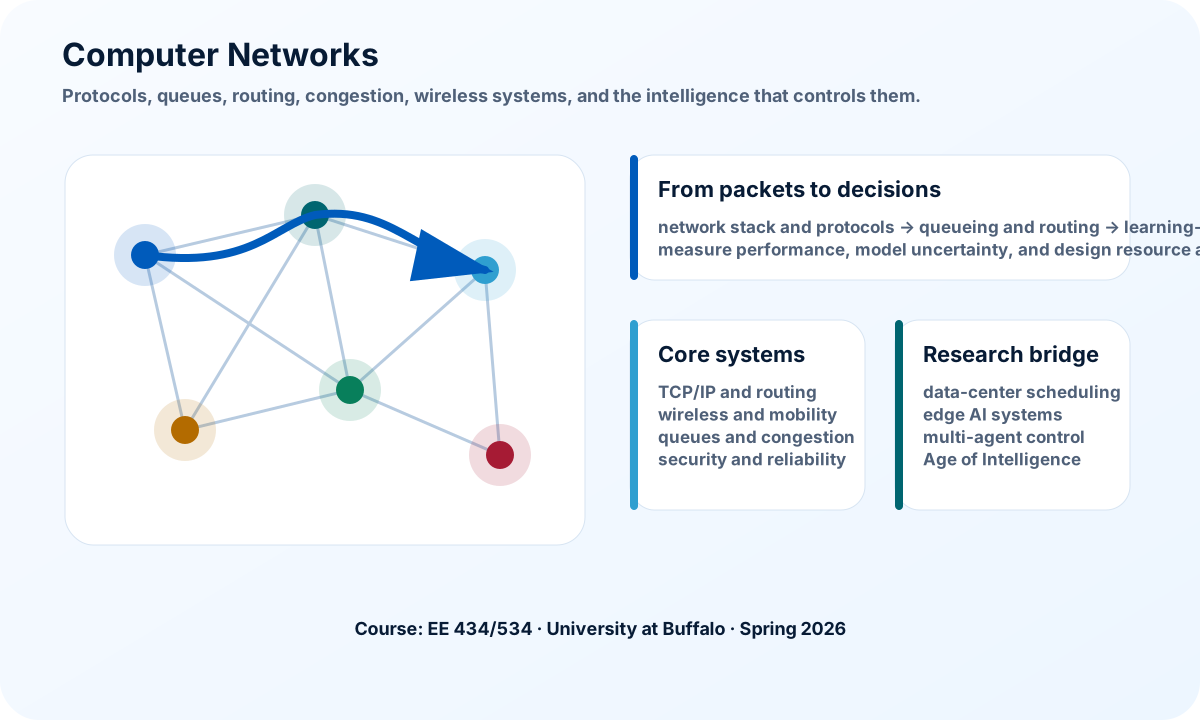
Computer networks illustration with nodes, routes, queues, protocols, and research connections.
EE 434/534 · Spring 2026

Principles of Networking

Students connect protocols and architecture to performance, congestion, routing, wireless systems, security, and the decisions that increasingly make networks adaptive and intelligent.

Undergraduate developmentnetwork stack, routing, congestion control, queueing intuition, system measurement
Graduate developmentoptimization and learning perspectives, research papers, design tradeoffs, open problems
Research connectionsdata-center routing, edge AI, network optimization, multi-agent control, Age of Intelligence

Additional teaching experience

Ohio State · Fall 2023

ECE 5101 & CSE 6461

Computer Communication Networks.

Purdue · Fall 2016 and Fall 2019

ECE 54700

Introduction to Computer Communication Networks.

Learning design

A pathway from mathematical foundations to research independence.

1

Visualize

Use one-, two-, and three-dimensional examples, diagrams, and interactive demos to make abstract objects concrete.

2

Formalize

Identify variables, information, objectives, constraints, assumptions, and the right performance metric.

3

Analyze

Build proof intuition, derive guarantees, examine counterexamples, and understand fundamental limits.

4

Implement

Test algorithms numerically, compare baselines, inspect failure modes, and connect theory to systems.

5

Communicate

Explain the result to classmates, researchers, engineers, teachers, and the public.

Educational outreach

Show how mathematics can model a real system—and help improve it.

Outreach activities use smart grids, autonomous systems, robotics, XR, biology, health, and community-scale questions to help learners see mathematics as a tool for understanding and designing the world.

2026

K–12 teacher engagement

Student-led demonstrations connected mathematical modeling to smart grids and autonomous systems, showing how theory generates decisions, insights, and real-world impact.

2026

EAS 202 Faculty Mentor Week

Introduced engineering students to research questions, faculty mentoring, and pathways from coursework to open-ended investigation.

2023–2024

NSF AI-EDGE REU

Supported undergraduate research experiences at The Ohio State University in AI, networking, and edge intelligence.

2023

LEGO FIRST League

Engaged younger learners through robotics, teamwork, and problem-solving at The Ohio State University.

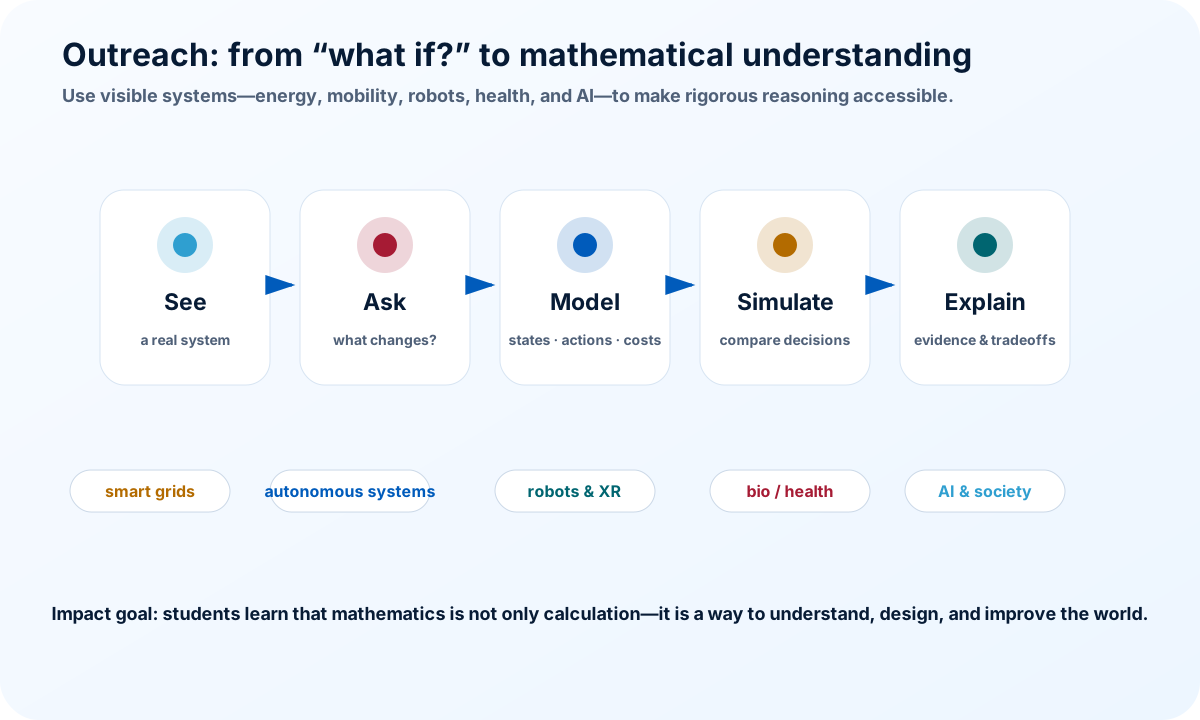
Outreach process from seeing a real system to asking questions, modeling, simulating, and explaining tradeoffs.
Outreach translates the same research habits—question, model, compare, explain—into age-appropriate experiences.
Outreach in development

Interactive “what-if” laboratories for schools and public demonstrations.

These activities are being developed to make feedback, uncertainty, resource allocation, and safe decisions visible through simulations and spatial computing.

Energy & environment

Smart-grid decision lab

Learners balance renewable generation, demand, storage, and reliability, then inspect how forecasts change decisions.

Mobility & robotics

Safe autonomy challenge

Learners control a robot or simulated vehicle while respecting collision, communication, and energy constraints.

Biology & health

BioDecision Lab

Learners use reinforcement learning and optimization to explore growth, treatment, diagnosis, and resource tradeoffs in simplified biological systems.

XR & spatial intelligence

Visible feedback loops

Mixed-reality demonstrations show how sensing, communication, model updates, and control interact around a learner.

Prospective students

What makes a strong research inquiry?

I welcome students interested in theory and mathematically grounded intelligent systems. A useful email briefly explains your background, the research questions that genuinely interest you, and how they connect to one or more current directions.

01

Describe your mathematical, algorithmic, or systems preparation.

02

Name a specific paper or research direction and explain what interested you.

03

Share a project, proof, implementation, or question that demonstrates initiative.

04

Attach a current CV and relevant transcript or writing sample.

Email Ming Shi